

Does Cubic Zirconia Look Real? The Truth
Table of Contents
- So, Does Cubic Zirconia Look Real?
- Cubic Zirconia vs Diamond: The Visual Differences
- Why Quality Matters in How Real CZ Looks
- Home Tests vs. Professional Gemstone Identification
- How to Clean Cubic Zirconia for Lasting Brilliance
- The Best Diamond Alternatives for Everyday Wear
- Final Verdict: Is CZ a Smart Choice?
- Frequently Asked Questions
Last Updated: September 6, 2026
So, Does Cubic Zirconia Look Real?
The short answer is yes: high-quality cubic zirconia can absolutely look real, often fooling the naked eye. Cubic zirconia is a synthetic gemstone crafted from zirconium dioxide, engineered to mimic the optical properties of a genuine diamond. At Diamond Veneer Travel Jewelry, we offer jewelry that captures the look and feel of fine diamonds.
Most people cannot tell the difference without a jeweler's loupe or a thermal conductivity tester. The confusion usually comes from low-quality stones that appear cloudy or overly rainbow-colored. Below, we break down how these stones compare, which tests actually work, and why quality determines everything.
Cubic Zirconia vs Diamond: The Visual Differences
At first glance, a well-cut cubic zirconia and a diamond look nearly identical. Both are colorless, brilliant, and catch light in dazzling ways. The differences only emerge when you understand the physics behind each stone's sparkle.
Cubic zirconia is a simulant, meaning it mimics a diamond's appearance but has a different chemical composition. A real diamond is pure carbon arranged in a crystalline structure, while cubic zirconia is zirconium dioxide. That distinction drives every visual and physical difference between the two.
Sparkle, Fire, and the Disco Effect
The most noticeable difference lies in how each stone handles light. Diamond has a refractive index of about 2.42, while cubic zirconia's is approximately 2.15. The lower number means CZ bends light less efficiently.
What matters visually is dispersion, the ability to split white light into spectral colors. Cubic zirconia has a dispersion rate of about 0.066, significantly higher than a diamond's 0.044. This means CZ produces more colorful flashes, often called fire. When light hits a CZ stone, it scatters into visible rainbows more readily than a diamond.
This excess fire creates what jewelers call the "disco effect." A cubic zirconia can look almost too sparkly, throwing rainbow flashes in every direction. Gemological Institute of America's guide to diamond simulants explains that trained eyes often spot CZ by this exaggerated rainbow play, since a genuine diamond reflects more white light with subtler color flashes.
Hardness and Scratch Resistance
Durability separates these stones in practical ways. Diamond ranks 10 on the Mohs hardness scale, the hardest natural material known. Cubic zirconia measures between 8 and 8.5, which is still impressively hard but noticeably softer.
That difference matters for everyday wear. A diamond will resist scratching from nearly anything it encounters. Cubic zirconia can scratch if it rubs against harder materials, though it remains durable enough for regular jewelry use. For rings worn daily, this means CZ may show surface wear over several years, while a diamond would remain pristine.
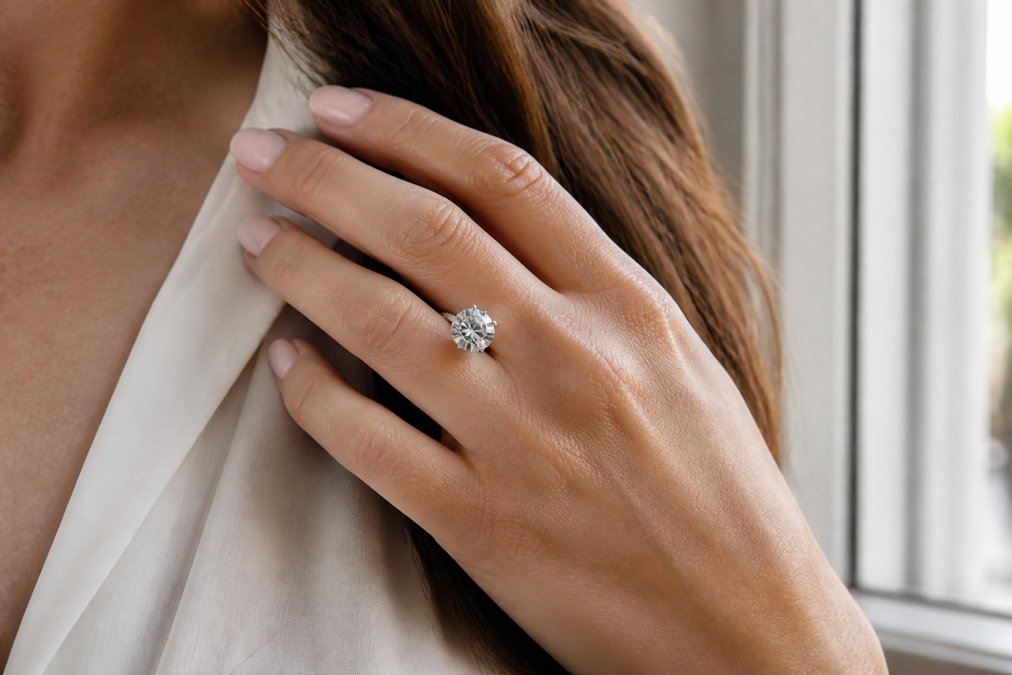
Why Quality Matters in How Real CZ Looks
Not all cubic zirconia is created equal. The gap between a convincing stone and an obvious fake comes down to manufacturing quality, cutting precision, and coatings.
Standard cubic zirconia often looks glassy or overly colorful because it lacks the refined cutting and polishing of premium stones. High-end CZ manufacturers cut their stones with the same faceting patterns used for diamonds, maximizing brilliance and minimizing the disco effect.
Coatings also transform appearance. At Diamond Veneer Travel Jewelry, our pieces use a unique carbon-coating process that achieves a G-color diamond grade, meaning the stones appear colorless rather than slightly yellow or gray. This treatment enhances the stone's brilliance and brings its visual profile closer to a genuine diamond.
Cut quality determines how light travels through the stone. A poorly cut CZ will appear dull or lifeless, while a precision-cut stone captures light and returns it to the viewer's eye with impressive intensity. When someone says they can always spot cubic zirconia, they are usually remembering cheap, poorly cut stones, not premium versions.
Home Tests vs. Professional Gemstone Identification
If you are wondering whether a stone is genuine, you have two paths: quick home checks or professional testing. Each has strengths and limitations, but the critical distinction is that home tests are unreliable for the exact type of high-quality, coated cubic zirconia that looks most real.
The Fog Test and Other Quick Checks
The fog test is the most famous home method. Hold the stone close to your mouth and breathe on it, creating a light fog. A real diamond disperses heat immediately, so the fog clears almost instantly. Cubic zirconia retains heat longer, meaning the fog lingers for a couple of seconds.
This test works because diamond has exceptional thermal conductivity, while cubic zirconia does not. However, the fog test is not foolproof. International Gem Society's guide to gemstone testing notes that environmental temperature and the stone's setting can affect results, making this a useful indicator rather than a definitive answer.
The deeper problem is that premium cubic zirconia is often coated to improve its optical properties. A carbon coating can alter the surface's thermal response just enough to blur the line between what a diamond and a CZ do in a fog test.
Other quick checks include the sparkle test, where you observe how much rainbow fire the stone throws, and the magnification test, where you inspect for rounded facet edges. Diamond facets are sharp and crisp, while CZ facets often appear slightly rounded under a loupe. But precision-cut CZ stones are cut with diamond faceting patterns, making this test less reliable than it once was.
Why Home Tests Fail on Quality CZ
Home tests are designed to catch cheap, poorly made simulants. They assume the stone you are testing has standard optical and thermal properties. High-quality cubic zirconia is engineered to defeat those assumptions, so the tests most people rely on, fog, sparkle, even magnification, produce ambiguous results.
What a Jeweler or Diamond Tester Reveals
Professional testing removes all guesswork. Jewelers use diamond testers that measure thermal conductivity, instantly distinguishing diamond from cubic zirconia. Since CZ conducts heat poorly, a diamond tester will not register it as a diamond. However, there is a catch: some advanced synthetic stones, like moissanite, can fool older thermal testers. That is why most professional jewelers now use combination testers that measure both thermal and electrical conductivity.
More advanced gemological testing examines refractive index and birefringence. Cubic zirconia is singly refractive, as is diamond, but instruments can measure subtle differences in light behavior. A trained gemologist using a refractometer can identify cubic zirconia with certainty.
The most definitive method is loupe inspection under 10x magnification. A gemologist looks for specific inclusion patterns, facet junction sharpness, and surface characteristics. Diamond has distinct growth lines and natural inclusions, while CZ is internally flawless and shows a characteristic orange flash under certain lighting. This level of inspection is what separates a confident identification from a guess.
Federal Trade Commission's jewelry guides offers consumer guidance on understanding gemstone disclosures, helping you know what questions to ask when purchasing jewelry.
How to Clean Cubic Zirconia for Lasting Brilliance
Cubic zirconia's main vulnerability is buildup. Body oils, lotions, and dust create a film that dulls the stone's sparkle over time. The good news is that cleaning is simple and restores brilliance quickly.
The most effective method is a warm water and mild dish soap solution. Mix a few drops of soap into a bowl of warm water, soak your jewelry for a few minutes, then gently brush with a soft toothbrush. Focus on the underside of the stone where oils accumulate. Rinse thoroughly and pat dry with a lint-free cloth.
Avoid harsh chemicals, ultrasonic cleaners, and steamers. These can damage the coating on premium cubic zirconia or loosen the stone's setting. With regular gentle cleaning, a quality CZ stone maintains its brilliance for years.
The Best Diamond Alternatives for Everyday Wear
Cubic zirconia stands as one of the most popular diamond alternatives, but it is not the only option. Understanding how each stone ages over time, not just how it looks on day one, is what separates a smart purchase from a regretful one.
| Stone Type | Hardness (Mohs) | Brilliance | Best For |
|---|---|---|---|
| Cubic Zirconia | 8-8.5 | High, with more fire | Everyday wear, travel, fashion |
| Moissanite | 9.25 | Very high, different fire | Engagement rings, daily wear |
| Lab-Created Diamond | 10 | Identical to natural | Heirloom pieces, investment |
| White Sapphire | 9 | Lower, more subtle | Understated elegance |
Moissanite offers exceptional hardness and brilliance, though it produces a different type of fire that some find too colorful. Lab-created diamonds are chemically identical to natural diamonds but cost significantly less. White sapphire provides durability but lacks the sparkle of CZ.
The Long-Term Reality: Cloudiness and Wear
Here is what most guides skip: how these stones look after two to five years of daily wear.
Cubic zirconia's main vulnerability is not scratching, it is cloudiness. Over time, micro-abrasions on the stone's surface and the accumulation of microscopic residue in the facet junctions cause the stone to lose its crisp brilliance. This is not a cleaning issue; it is a surface degradation issue. A CZ stone that was once indistinguishable from a diamond will, after a few years of daily ring wear, develop a slightly hazy or milky appearance.
A ring worn daily through dishwashing, hand washing, and lotion application may show visible cloudiness within two years. A pendant or earring worn less frequently can stay brilliant for five years or more.
Moissanite does not cloud; its hardness of 9.25 resists the micro-abrasions that dull CZ. Lab-created diamonds are essentially permanent. White sapphire, while hard, tends to accumulate dirt and oil more readily because it lacks the optical properties that make CZ and moissanite self-cleaning to some degree.
The Ethical and Environmental Angle
Natural diamond mining has well-documented environmental and ethical concerns, including habitat disruption and the history of conflict diamonds. The Kimberley Process, established in 2003, was designed to stop the trade in conflict diamonds, though critics note it has gaps.
Cubic zirconia is manufactured in laboratories, which means no mining, no conflict, and a relatively small environmental footprint. Moissanite is also lab-created, with a similar ethical profile. Lab-created diamonds offer the same ethical advantages as CZ, but they require significantly more energy to produce because they replicate the extreme heat and pressure of natural diamond formation.
For the environmentally conscious buyer, the choice is whether you want a stone that is chemically identical to a mined diamond but produced in a lab, or a simulant that mimics the look without the environmental cost of diamond synthesis. Both are ethical choices; the difference is in the manufacturing process and the price tag.
The Practical Verdict
For most people, cubic zirconia offers the best balance of appearance, affordability, and practicality. You get the look of a diamond without the anxiety of wearing an expensive stone, making CZ particularly suited for travel, daily wear, and fashion-forward pieces you want to change frequently.
But if you are buying a ring you intend to wear every day for a decade, the math changes. A moissanite ring costs more upfront but will not cloud. A lab-created diamond costs more still but offers permanence. The question is which stone will still look real in five years.
Final Verdict: Is CZ a Smart Choice?
The answer depends on your priorities. If you value the prestige of owning a natural diamond, no simulant will satisfy you. But if you want jewelry that looks beautiful, sparkles convincingly, and costs a fraction of a diamond's price, cubic zirconia is an intelligent choice.
The key is selecting quality pieces. A well-cut, properly coated cubic zirconia stone from a reputable source will look real to virtually everyone you meet, survive daily wear, clean up beautifully, and let you enjoy luxury aesthetics without the financial risk.
For travelers, CZ jewelry solves a real problem: you can carry stunning pieces without worrying about loss or theft. For fashion-conscious women, it means owning multiple styles without draining your budget. For anyone who loves beautiful jewelry, it offers the simple pleasure of wearing something gorgeous every day.
Frequently Asked Questions
What is the downside of cubic zirconia?
The primary downside is durability. On the Mohs hardness scale, cubic zirconia scores 8 to 8.5, which is lower than a diamond's perfect 10. This means it can scratch over time with daily wear. It can also lose its polish and become cloudy if not cared for properly. However, high-quality pieces using advanced coatings are more resistant, and with correct cleaning, a CZ piece can maintain its look for years, making it a practical choice for travel and daily style.
Can a jeweler tell the difference between CZ and a diamond?
Yes, a professional can easily tell the difference. Jewelers use a diamond tester that measures thermal conductivity; diamonds disperse heat rapidly while cubic zirconia does not. They also use a loupe to inspect the stone's facets and internal structure. A diamond's crystalline structure and sharp facet edges look distinct from CZ's rounded girdle and different internal patterns. While CZ is visually similar to the naked eye, gemological tools provide a definitive answer.
How does carbon-coating improve cubic zirconia quality?
Carbon-coating is a technique used to enhance a CZ stone's optical properties. A microscopic layer of carbon is applied to reduce the stone's 'disco effect' or the rainbow flashes that look unnatural. This process allows the stone to reflect more white light, mimicking the brilliance and fire of a high-grade diamond. The result is a stone that achieves a G-color grade, appearing colorless and more convincing, closing the visual gap between a simulant and a genuine diamond.
Does cubic zirconia lose its sparkle?
Cubic zirconia does not lose its internal sparkle, but it can appear dull on the surface. This happens because CZ attracts dust and oils from your skin, which creates a film that reduces light refraction. The good news is this is easily fixed. Regular cleaning with warm water and mild dish soap will restore its fire and brilliance. Unlike diamonds, CZ can also accumulate microscratches over many years, which can diminish its polish, but proper care prevents this.
The truth about cubic zirconia is that it looks as real as the quality you choose. Premium carbon-coated stones from Diamond Veneer Travel Jewelry deliver G-color diamond grade appearance, crafted in sterling silver, 14K gold, and stainless steel for pieces that feel as luxurious as they look. Get started with Diamond Veneer Travel Jewelry and experience jewelry that lets you travel, celebrate, and shine without compromise.